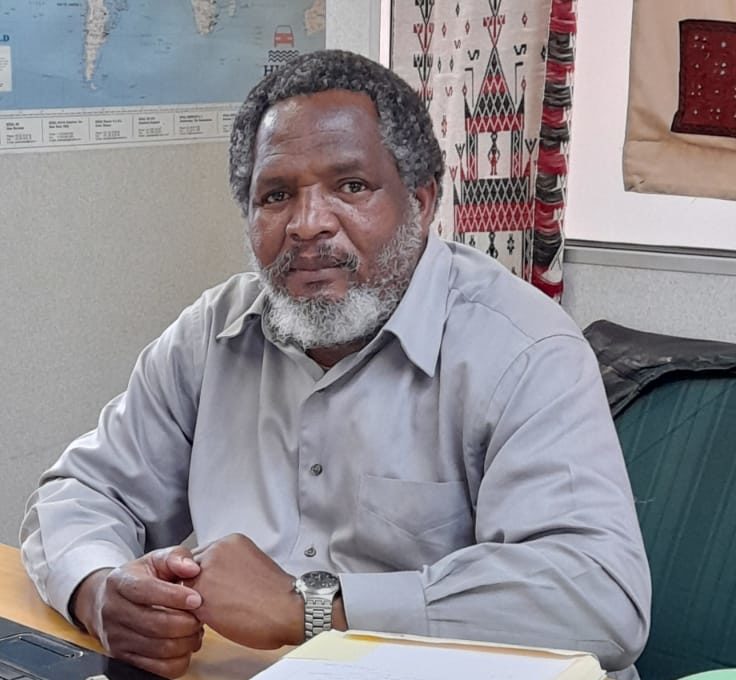
Mduduzi (Mdu) Phenyane (South Africa)
Caretaker and Receptionist
Mdu lives in Durban and is working in a part-time position as a caretaker and receptionist in StreetNet’s office.

Mdu lives in Durban and is working in a part-time position as a caretaker and receptionist in StreetNet’s office.

StreetNet International has developed a new project, aimed at mobilizing youth activists and bridging the information gap between StreetNet and its affiliate organizations. The “Youth Reporters on the Ground” was officially launched in June 2021, with 11 participants from SNI affiliates from different countries. Until December 2021, these youth reporters will be following trainings on communication and report on the activities of street vendors and their organizations.
A project for youth empowerment
In many countries, educated, creative and hardworking young people face many challenges when attempting to enter the formal job market, which leaves a huge number of people without opportunities. Youth unemployment is a global challenge that pushes many young people to be engaged in informal economy jobs. Many of our youth reporters are currently enrolled in university or hold university degrees, but the majority also has experience as street vendors as a way to make ends meet. However, they mostly have larger dreams to transition to the formal economy, especially to work as journalists.
These young people have a lot of potential and can become fierce defenders of informal economy workers’ rights, if they are given the chance. But we have to empower them – develop their skills, showcase their work, and bring them closer to StreetNet as a global alliance they can leverage to make a difference in their own communities and potentially become great leaders by themselves and inspire others.
Networking for global solidarity
Young street vendors are an asset for their organizations, but they are often disconnected from each other. Since young street vendors do not usually hold leadership positions, they do not have the same opportunities to participate in international events to foster solidarity. That is why projects that involve young street vendors from several countries are important – for these young people to understand that there are many others like them and that they can work together, now and hopefully in the future.
Global alliances of informal economy workers, such as StreetNet, aim to foster global solidarity. And that is exactly what we hope to achieve with the Youth Reporters on the Ground project.
Bridging the information gap
As a global organization, StreetNet is present in over fifty countries. This means it is a challenge to collect live information, stories, quality videos, and images from all regions and countries on a regular basis. Many of our affiliates also struggle to have a designated person responsible for communication – often, other pressing issues take precedence. However, communication is key to mobilize workers, combat the stigma against street vendors, pressure decision-makers and raise-awareness of the issues faced by informal economy workers.
Therefore, by training young people members of our affiliate organizations, we can bring their communication to a more professionalized level. We will also be able to have a committed group of advocates to rely on whenever we need communication materials or information related to the situation in a given country or region.
This strategy favors StreetNet as a global organization, but it also contributes to the capacity-building of our affiliates.
Communication for social change
This project will not simply equip the participants with communication skills, such as knowing how to take a photograph or storytelling. It will do so with a focus on fostering social change. That means knowing about many other issues, such as how to use stories for advocacy purposes and be aware of ethical issues in the visual depiction of street vendors. It also means learning how to use communication to influence and change people’s lives in a respectful, engaging, and participatory way.
In the words of our International Coordinator, Oksana Abboud:
“Youth is a trigger for any possible change in society, that’s why focus and investment in youth will be always a priority for StreetNet development and sustainability strategy. The Youth Reporters Project is a great initiative to start active engagement and involvement of youth among StreetNet affiliates through capacity building and empowering them to become future leaders of their organizations and communities”.
Who are our Youth Reporters?
Click on the images below to get to know our Youth Reporters in their own words! Their first assignment is to tell us a bit about themselves, why they became advocates for the rights of street vendors and why they chose communication as a tool:
Denis Kalungi (UMAEU – Uganda)
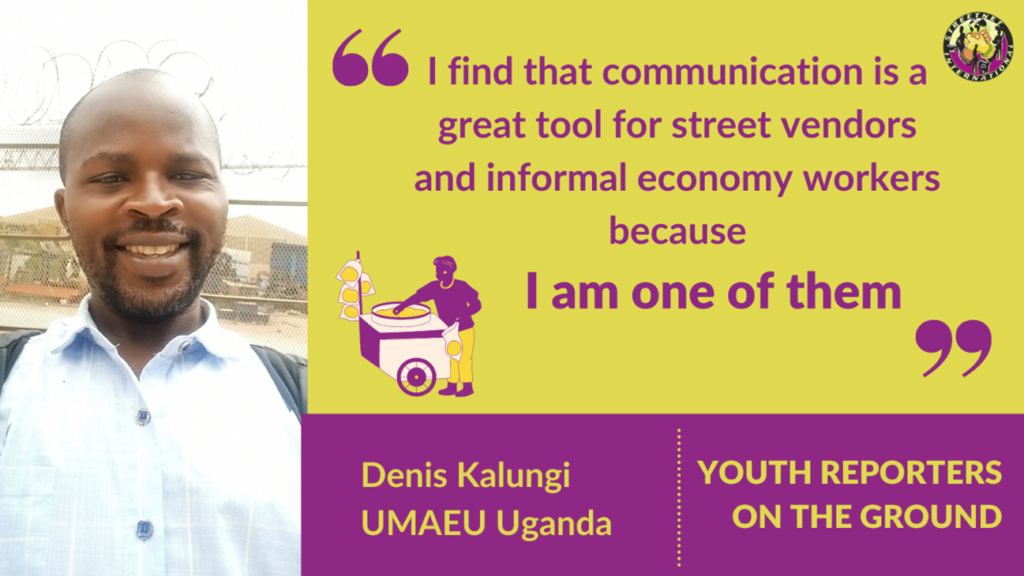
My name is Denis Kalungi. My nationality is Ugandan and I am 34 years old. I was born in a town called Lugazi. My parents worked in Lugazi sugar factory. That gave me the chance to know and become friends with Mr. Mehta, the owner of the sugar-corporation of Uganda. He introduced me to golf and while I lived there, I had the chance to become a good golfer because Mr. Mehta owns a golf club.
Me emerging as a good golfer prompted Mr. Mehta to pay tuition for my Bachelors’ Degree in Information Technology at Kampa International University. Four years after my graduation, I started working at Banda Market, which is found in Kampala, the capital city of Uganda.
I worked in the market as a vendor to earn an income. There, I heard about a meeting of the Uganda Markets and Allied Employees Union (UMAEU). I recorded the scheduled date and attended the meeting. For all the issues that were raised, I managed to offer a way forward for them. This gave me a warm welcome by the General Secretary for UMAEU, because he had met a committed person.
This happened at a time in which they were about to close the election of the next Executive members. My name was suggested, and people voted for me as Deputy Secretary in Research. This helped me to understand social justice, human and workers’ rights, and trade unionism inside and outside of Uganda. It also motivated me to write the UMAEU strategic plan, which is not yet implement due to a lack of funds.
Since I am currently shepherd of many herds from Kireka Christian fellowship and a global teacher and writer of God’s message (at https://awakeningsaints.org), I felt responsible to have an economic and social impact in people’s lives.
As the informal economy is my origin, I find that communication is a great tool for street vendors and informal economy workers because I am one of them. We have been finding difficulties to present our challenges and sometimes, even when we get the chance to do so, we don’t know how to do it. Today, I find it important to create a global network throughout the world and mobilize younger activist who have been stigmatized for so long, with the hope that this IS the time for mobilization and to bridge the information gap between vendors in our union and StreetNet through storytelling, data gathering and article writing. Stay blessed.
Djenabou Sow (CNTG – Guinea)
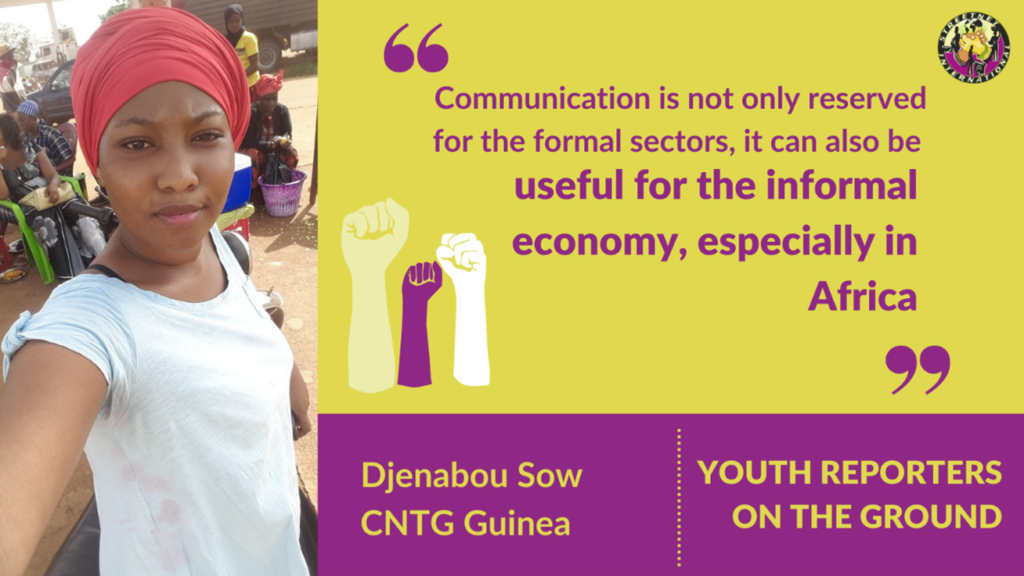
My name is Djenabou Sow and I am 20-years-old. I am an activist, a feminist, and I come from Guinea-Conakry.
The informal sector is considered harmful by the formal sector because it does not pay taxes and can therefore sell at a lower cost. It is a sector where the State does not control the activities of its people, where there are no support measures, no assistance, and no legal and organizational guidelines from the State. Nowadays, the informal economy is an activity linked to all: to immigrants, unemployed, children with families and abandoned children, and by women who have family responsibilities and who fight everyday to survive. They are only trying to get through the day. They are not covered by the national social security fund. However, this sector has become a concern for most of the population.
Communication is linked to any economic, social and cultural development, which affects all income-generating activities. Communication can use several channels: editing and broadcasting of videos, doing interviews, taking photos, publishing magazines, posting, and sharing on social media (Facebook, Twitter, LinkedIn and Instagram), which can immerse people and affect their reality. However, communication is not only reserved for the formal sectors. It can also be useful for the informal economy, especially in Africa. But most communication focuses on developed countries and the formal sector. We should also leverage it to support informal entrepreneurial activities.
My skills are diversified: I performed different tasks which led me to be versatile. My formal education in economic philosophy, managing social media, and writing and collecting information.
Edna Sibanda (SAITA – South Africa)
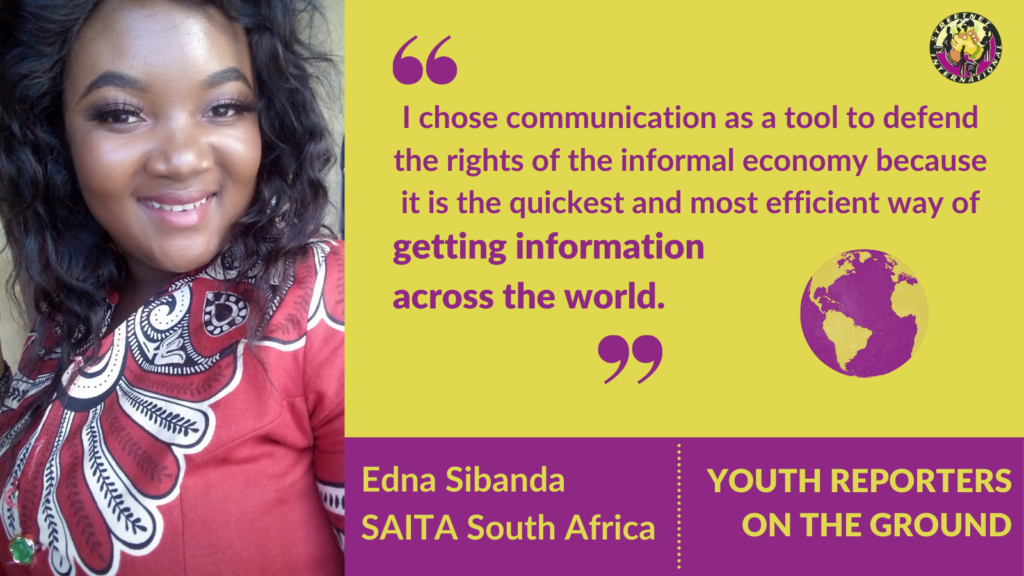
My name is Edna Sibanda and I am 21-years-old. I am from South Africa, from the capital city of the North West called Mahikeng. I am an informal trader, an aspiring entrepreneur and a future broadcast journalist. I am a member of the South African Informal Traders Alliance (SAITA), which is an affiliate of StreetNet International.
Informal traders are faced with so many challenges on a daily basis. Not having proper advocacy for them does not aid in any of their struggles. Being an informal trader myself is one of the reasons why I care so much about the rights of informal traders. One of the biggest reasons why it is so important to advocate for our rights is because local municipalities have been developing by-laws or policies that were intended to make trading easier, but these policies have over the years proved to be null and void.
I chose communication as a tool to defend the rights of informal economy workers because it is the quickest and most efficient way of getting information across the world. Social media has been the most accessible communication tool in recent years, and it has been reliable to generate feedback within a short time. This proves that communication is the best way to advocate for the rights of informal economy workers’ communities.
I have achieved so many things since I joined the informal community and I have developed a lot of skills within a short time. Starting my own business at the age of 17 has been by biggest accomplishment so far which I am proud of.
Dorcas Rachetée Ishimwe (SYTRIECI – Rwanda)

I am Dorcas Rachetée Ishimwe, a 21-years-old Rwandan. I have a passion for advocating for people and mass communication in general. That is why I am currently pursuing a Bachelors’ degree in Mass Media and Communication.
I work as a Communication Officer in an organization called SYTRIECI, which is affiliated to StreetNet International. I started working for this organization when I was 18, and it was a very big help to me as I was following my communication studies. I have learned a lot through these almost four years I spent with SYTRIECI and now I can say that advocating for human rights is a big part of my life.
I grew up in Kigali, the capital city of Rwanda, with my three younger brothers and my parents. I love taking pictures, writing and reading in my free time. Surprisingly, I do all of that while listening to music. I also love to travel, even though I haven’t been able to do it as much as I wanted due to COVID-19. Hopefully, it will end soon.
I recently was selected to be one of StreetNet International Youth Reporters on the Ground and I am very excited and thrilled to experience this new opportunity. I wish you all a great and healthy life ahead!
João Lucas Gama (UNICAB – Brazil)
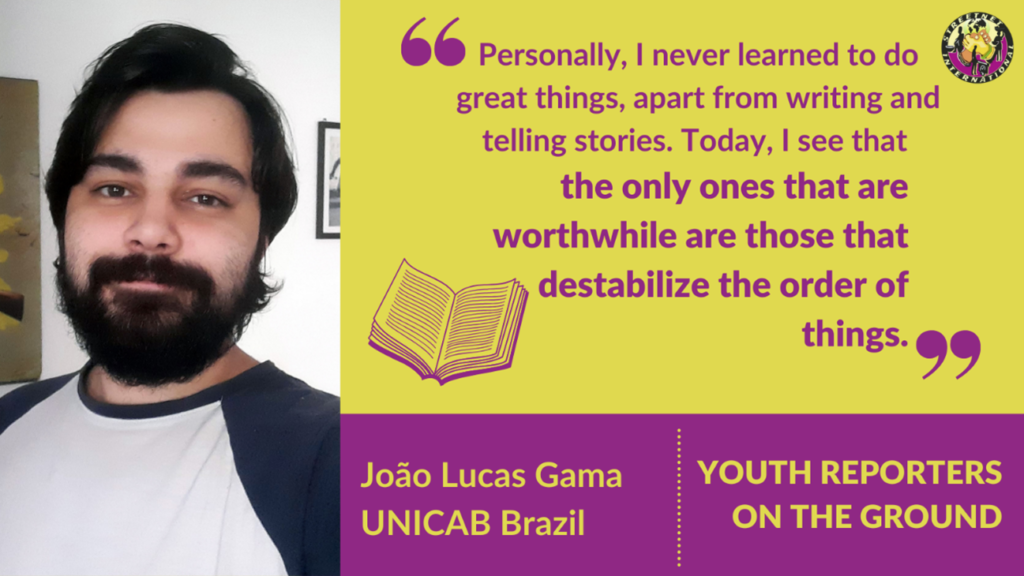
I am pleased to meet you. I am João Lucas Gama! I grew up in a place called Camaragibe, on the outskirts of Recife (where I currently live). I believe that no one becomes themselves alone, so to tell you about me, I need to talk about other people first.
I am the son of a woman named Ywanoska, a name of Russian origin in Latin American lands and that, by itself, would yield an excellent novel of fantastic realism. A teacher highly influenced by Paulo Freire’s ideas, she sought to practice a libertarian and socially engaged education. Passionate about literature and the art of storytelling, she ended up giving me the habit of reading and, because of her, I started to create my own plots.
I remember that on her days off, when we would go to the beach or the park, she would sit for hours, always watching us, as she flipped through books and magazines she couldn’t read during the busy weeks. At those times, I looked at her from afar and thought: “one day I will write stories for her, so that she can read when she no longer has to work”.
Years passed and I was able to study journalism. During my studies, I got involved in political activism in mid-2013, when Brazil was getting ready to host the World Cup. At the time, several movements began to emerge and/or gain notoriety in Recife, establishing the Right to the City and proposing to re-signify the urban space. Among them, one in particular caught my attention: the Informal Trade Workers’ Union of Recife (SINTRACI).
Its self-managed form of organization was, for me, a transformative experience, as it seemed to herald a new labor vanguard that moved away from the plastered and physiological practices adopted by conventional union structures in Brazil, while also expanding the understanding of the “working class”, making it more heterogeneous and highlighting the need for reconstruction and humanization of our cities.
It was through friends and fellow activists that I was able to meet some of the leaders of this movement, who quickly became good friends and, above all, references in the struggle. Together, we developed (in an amateurish way and without resources) a small webseries entitled “Fala Informal” (“Informal Chats”), where workers in the informal economy spoke about their lives, impacted by social inequalities, prejudices, police violence and the denial of human and constitutional rights – something that I came to call the “informal existence”.
Since then, I have not been separated from the struggles waged by street vendors, which I started to follow more closely, in street acts and assisting in UNICAB’s communication. It is increasingly clear to me that journalism and communication are fundamental fields of dispute over ideas and social transformation that need to be occupied by workers, reflecting their needs in an inclusive and radically democratic way.
Personally, I never learned to do great things, apart from writing and telling stories. Today, I see that the only ones that are worthwhile are those that destabilize the order of things. I no longer dream of writing for retired teachers, but of helping people tell their own stories, in order to create collective narratives and new life possibilities.
Nancy Likiripa (ZCIEA – Zimbabwe)
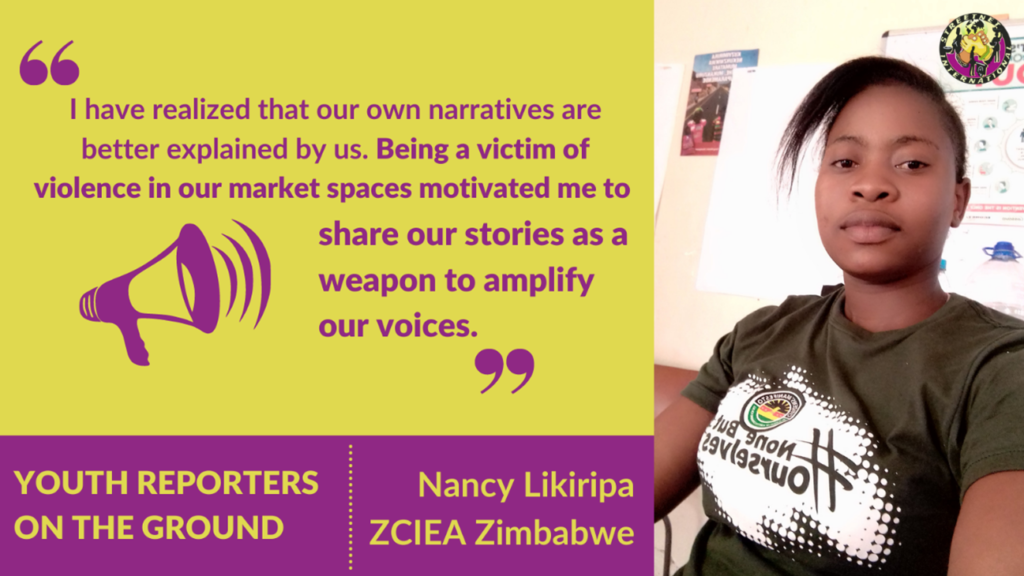
My name is Nancy Likiripa. I am from Zimbabwe, and I am 25 years old. I am currently pursuing a degree in Development Studies. I am also looking forward to studying a Master’s in Media and Communication. As a member of ZCIEA, I have been selected as a Youth Reporter by StreetNet International.
I have realized that in my country many young people are in informal trading. I am also a street vendor. I am so passionate about workers, our safety, and the rights of street vendors. The current situation caused escalating violations in our workplace. I have realized that our own narratives are better explained by us. Being a victim of violence in our market spaces motivated me to share our stories as a weapon to amplify our voice.
I am now a whistle blower regarding informal traders’ rights, and I have managed to engage the local authorities and duty bearers for better marketplaces. I am also engaged myself in citizen journalism to create enough evidence for our voices to be heard.
Parvin Alizade (Eastern Europe and Central Asia region)
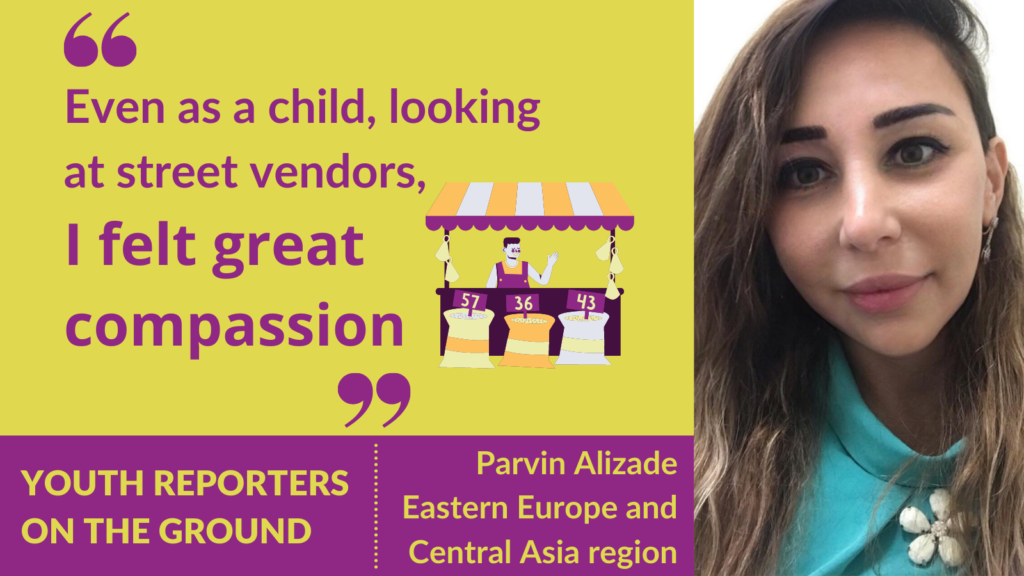
My name is Parvin Alizadeh. I worked as a teacher for a long time. After applying for a job at Xhidmat-Ish, I heard about the organization StreetNet. I was pleasantly surprised that there is such an organization. I was also glad that Azerbaijan and our organization Xhidmat-Is are member of this organization. I believe that in Azerbaijan, the rights of street vendors need to be protected, since their number in our country has always been high. They have always sold rural products, vegetables and fruits, mainly on the streets of the city. I always thought that their rights should be protected.
Even as a child, looking at street vendors, I felt great compassion. On cold days, when ordinary people work in offices and after they rush to their warm homes, street vendors have to endure the wind and cold. It should be reminded that in Azerbaijan, in Baku, the winter temperatures can reach 1Cº, also because Baku is also called the “city of winds”, they have to endure the wind, which on average is 6.7 meters per second, sometimes reaches up to 30-40 meters per second. Every time I ran home from school, I looked at them and felt compassion, sometimes stopping to buy something, knowing that the need makes them endure this cold.
In addition, these people are deprived of the basic provision of human needs. They can’t eat normally, they are forced to drink and eat on the street, mostly starving. It is also difficult for them in the summer, since the temperature in Baku reaches +42 in summer, street vendors, despite the possibility of sunstroke, also sell on the street. In the summer, you can see these street vendors on the roads on the way to the regions of Azerbaijan. These scenes are familiar to every Azerbaijani and guests of the city and country. And like any humane person puts himself in their position, assuming their role.
Many people understand that this trade is the only income of a person, and therefore of the family as a whole. Seeing their condition, I always thought that they needed support, but my support so far consisted only of buying their goods, I could not pass by an old grandmother who sells trinkets or something like that without buying something. I have seen tall, stately men who trade in the street and they look at you begging, that you buy something from me. I have always treated these people with respect, they do not steal, do not beg, they sell their products wherever they can, while sometimes tolerating different people. As if we were sorry, but not all people treat them with compassion, sometimes the police, fulfilling their duties, asks them to leave the places of trade. I am very glad that today, through your organization, I had the opportunity to help them not only passively, but at least, somehow participate in the process of improving their condition.
I would like them to also unite in groups, for example: grocery vendors, vegetable vendors, etc. This would help us to hear their problems, and in the future to involve the authorities and local municipalities, organizing two or three-sided dialogues. I really hope that if we, me included, will be able to improve their condition by at least 1%, I will consider myself a little happier. I am very glad to join StreetNet and I really hope that we can make at least some steps and with joint efforts we could achieve some improvement in street vendors condition of not only in Azerbaijan but also in other countries too.
Stanley Diaz (FESTIVES – El Salvador)
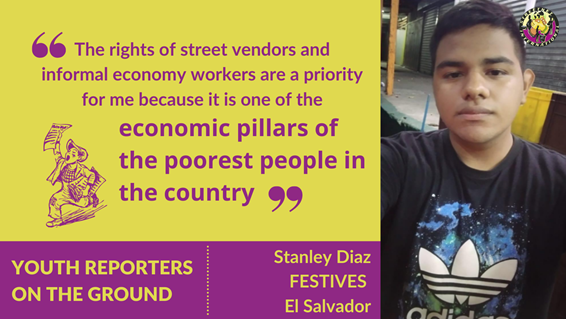
My name is Stanley Diaz and I am from El Salvador, a country located in Central America.
The rights of street vendors and informal economy workers are a priority for me, because the informal economy is one of the economic pillars of the poorest people in the country, who therefore need to resort to the informal economy in order to survive. We will continue this struggle until we can achieve a dignified life for all in the informal economy and a law that protects its workers.
I chose to invest and belong to the communication team so that the country and the world can be given a perception of what it is like to work in the informal economy through photos, videos and interviews, and to ensure there is a more conscious thought about the sacrifices that are made, day by day.
Plamedie Kingualu Mavivana (LDFC – DR Congo)

As a worker in the informal economy, I care about the rights of street vendors and workers in the informal economy because the survival of 90% of households in the DRC depend on the informal economy, which allows them to pay for schooling of children, rents, and health of the family.
My concern in this training is to promote the access of “invisible” workers, such as street vendors, to safe health coverage because they are exposed to accidents.
I chose communication as another way of defending the right of street vendors and informal economy workers, because communication is a means to defend our ideas. We can come into contact with the world and claim the rights of street vendors, because media is the 4th power of a country.
By choosing communication as another defense of the rights of street vendors and workers in the informal economy that communication is a means by which we can express our ideas to come into contact with the world to claim the rights of salespeople because communication is the 4th power of a country.
Thanks to communication we can convey information and train street vendors about how to promote their invisible work through communication tools.
Communication helps us reach out to customers to combat declining profit; it allows us to connect with the public instantaneously.
Uthman Kaisi (MUFIS – Malawi)
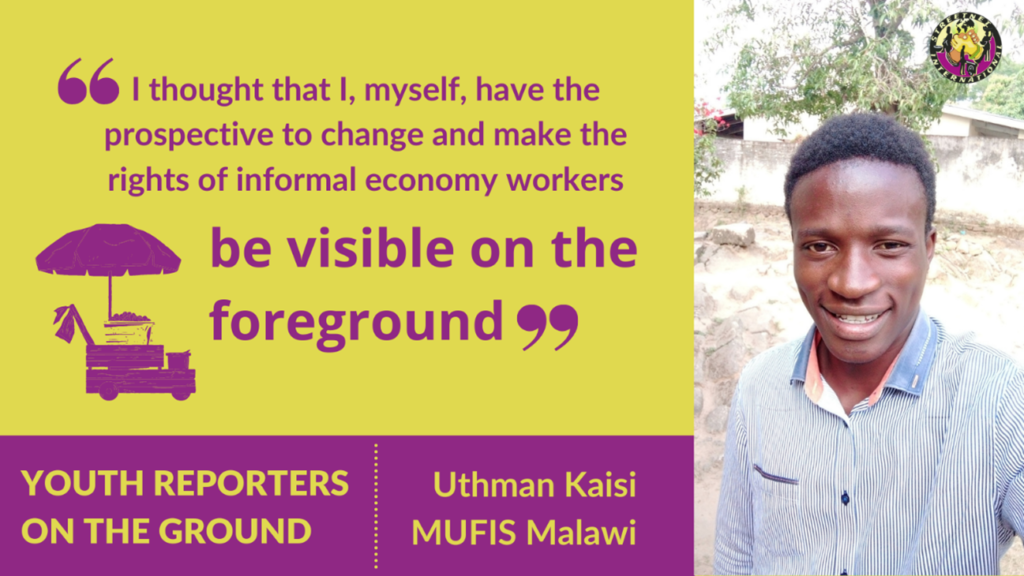
My name is Uthman Kaisi and I was born in the outskirts of the Blantyre city in August 1999. I am the youngest in a family of eight, of which I know six. I have resided most of my life in Sigerege village. Different circumstances have been happening in my life which led me to this path I find myself in.
I grew up in a family in which the breadwinner, my father, was working at a certain company in the middle of the city. The money which he earns monthly was not even enough to pay the school fees for all of us. What about basic needs? This life caused a lot of stress to my father and to the entire family. I remember my mother used to bake African cake. also known as Zigumu in the local language, to help support the family. I finished my primary school without much financial problems, as it required a small amount of money and my good performance at school allowed me access to other things such as notebooks.
Despite my visions of the future and good intentions to pursue secondary school studies, many circumstances influenced my path. I was devastated that I could not make my dreams come true. All I needed was to complete secondary education and become part of the Fourth Estate, the media. As my dream was to be a journalist, I read many different articles whenever I could. But, mostly, I used to listen to the radio because we had one at our house. A story about a vagabond, a rogue and a vendor that led to a change in the law encouraged me to pursue my dream.
I thought that I, myself, have the prospective to change and make the rights of informal economy be visible on the foreground. The informal economy contributes greatly for the development of the country, yet they are the ones which are always underestimated. They cater to the needs of a large number of customers from a lower- and middle-income class and contribute significantly to the economy. Many of them also generate revenue for the cities through payments for permits and fees and other kinds of taxes.
Through my experience on how the informal economy is being looked at, I thought of how to defend informal economy workers. For many people don’t know how the informal economy is important to the entire economy. What they need is to be given that knowledge. So, communication is the best way to defend informal economy workers against malpractice and educate people so they can understand the issues better.
I always dreamed of being one of the media practitioners. Even though I have been going through many difficulties, I fortunately found myself in tertiary education where I am studying what I always wanted. This is also a chance to fulfill what I dreamed: civic education and changing people’s mindsets through media.
Pearl Lawrence (KTB – Lesotho)
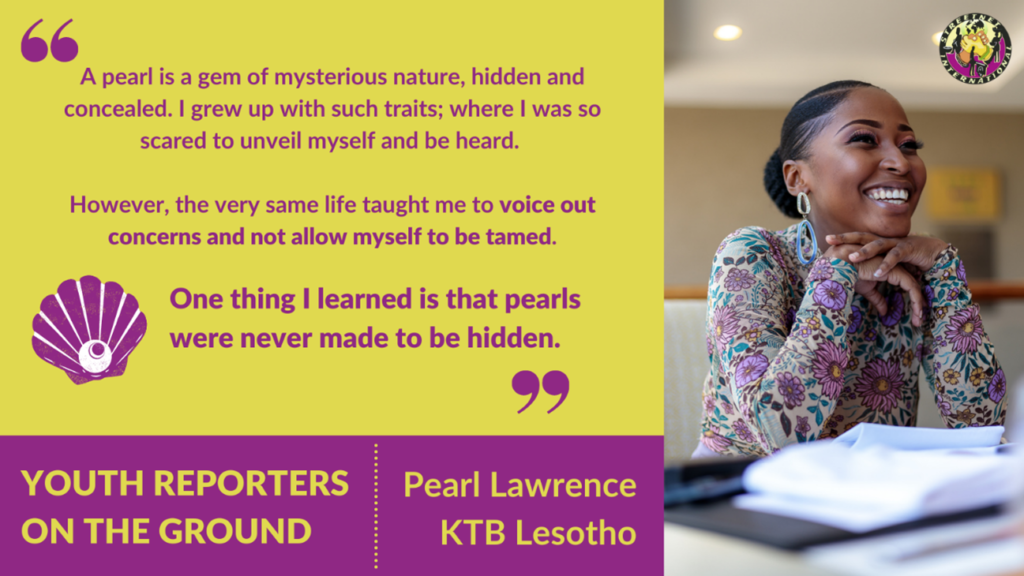
A pearl is a gem of mysterious nature, hidden and concealed. I grew up with such traits; where I was so scared to unveil myself and be heard. However, the very same life taught me to voice out concerns and not allow myself to be tamed. One thing I learned is that pearls were never made to be hidden, they ooze with so much profundity that is just waiting to be explored.
Furthermore, I have been exposed to information of what goes on in the world from a very young age. Having a father who is a journalist and a mother who worked for the national bank, there was emphasis on knowing what was happening in the world and the problems it faced. The house was filled with books on political leaders and African literature to newspapers and for a curious person like me; I could not wait to explore, indulge and ask a thousand questions. Unaware that I would grow to become a macroeconomics enthusiast.
I hold a BA(Hons) in International Business from the Limkokwing University of Creative Technology and I was tenured as a Student Ambassador. I served the institution for three years and I learned that leadership does not only entail holding a higher position but most importantly serving the people. This became the prevalent motive behind my career and leadership journey and taught me to be humble. This assisted me with core competencies of functioning under pressure, being more reliable and accountable, staying ahead of situations and forecasting them properly.
As an academic scholar, I flourish in independent research opportunities such as my final year thesis which focused on the Socio-economic impact of Letseng Diamond Mine on local communities in Mokhotlong. The research challenged me to execute great analytical, investigative and critical thinking skills. Furthermore, I was able to establish a movement named She’s Outta Your League (SOYL) which focuses on one of the UN sustainable development goals of woman empowerment. It aims at giving them a platform to voice out social concerns and eradicate being tamed by societal chauvinism through activism. Into the bargain, it addresses empowerment in a unique way that steers women into financial independence through business mentorship and financial health programmes.
Through this, I was able to start my beauty product, Tupperware business as an informal trader and got to experience the challenges and inequalities faced in the country. With the opportunity to advocate for StreetNet, I will dedicate my experience to ensure an enriched economy of Lesotho and I intend to develop global networks through active participation in the programs necessary for my contribution to Lesotho’s development in the future. In addition, I aim at dedicating myself to the country and Khathang Tema Basotho (KTB) in relation to informal trading and getting involved in negotiating and reforming policies of street vendors, ensuring economic development and growth in order to ensure inclusiveness, improve the standards of living of Basotho, eradicate poverty and instability in Lesotho and Africa at large.

Annelene Shahbaz joined StreetNet International as a Finance administrator in July 2011. She was retrenched in 2014 and reemployed on a part time basis in 2015. She was employed full-time again in December 2016 and was Promoted to Administration and Finance Manager in June 2019.
Annelene holds a Diploma in Business Studies and Financial Management. Annelene is very passionate about working with figures. She believes that good Financial Management plays a huge role in any organization and helps drive the organization forward.
Prior to working with StreetNet International, Annelene worked as an accountant at various organisations, these raging from a construction company, a printing company and an accounting practice. Annelene has over 18 years’ experience in Business, Finance Management and Administration.
Annelene is based at the StreetNet International Head office in Durban, South Africa.
Email: accounts@streetnet.org.za
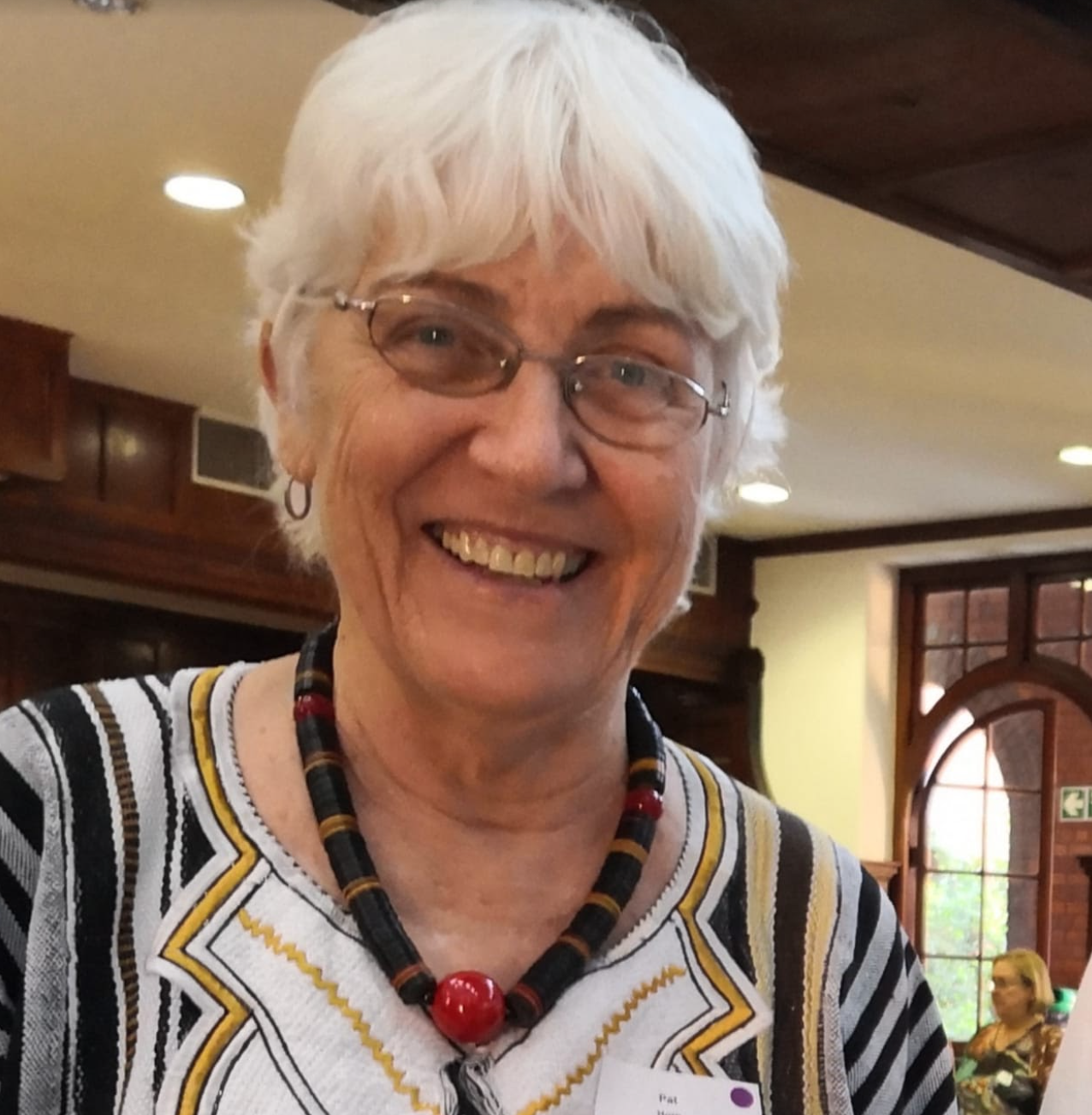
Pat Horn founded StreetNet International with its international base in Durban, South Africa, on 14th November 2002, after three years of preparation from 2000 to November 2002 together with Nozipho Lembethe, founding administrator. Pat worked as the International Coordinator from the foundation of StreetNet until the end of May 2019 after the Sixth StreetNet International Congress in Issyk-Kul, Kyrgyzstan, where it was agreed to hand over the coordination of StreetNet to her successor, Oksana Abboud. She drew on her experience as a trade unionist in the formal economy in South Africa from 1976 – 1991, in developing new ways of organizing workers in the informal economy and establishing StreetNet as a new global federation of organized workers in the street vendors’ sector of the informal economy. She now serves as Senior Advisor to the leadership, members and staff of StreetNet.
Email: advisor@streetnet.org.za
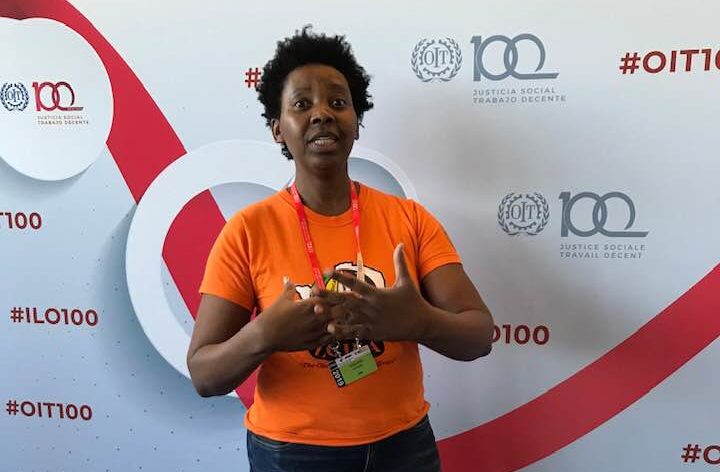
StreetNet International, representing more than 600 000 members in the sector of street vendors, informal market vendors and hawkers organised in 54 affiliated organisations in 50 countries in Africa, Asia, the Americas and Eastern Europe, expresses its deep concern with the current situation in South Africa where street vendors and informal traders from other neighbour countries have fallen victims to the violence and looting and currently are experiencing a xenophobic attacks.
Streetnet International condemns
the violence against immigrant traders and street vendors exercised in South
Africa and calls for tolerance and peace, proper treatment and respect towards
each human and worker despite the nationality and residential status.
StreetNet is committed to
improving the lives of street vendors in all countries of the world, to oppose
xenophobia and to discourage member organisations from adopting xenophobic
policies or practices in relation to foreign nationals from other countries.
One of the StreetNet Resolutions, adopted during its first Congress in 2004 on “Foreign and migrant street vendors”, clearly addresses prevention of xenophobic attacks towards immigrant informal traders and, in its turn, “encourages informal market vendors, street vendors and hawkers in different countries to engage voluntarily in trade with each other, and to develop the suitable terms and conditions for such trade to their own advantage”.

by Amar Kharate, StreetNet Trainee Organizer
StreetNet is affiliated to the IFWEA for quite a long time. In December 2015, Sibailly Douhouré – StreetNet Organizer and Educator – was elected as an IFWEA Executive Member. As a member of the Executive Committee, brother Sibailly attended a recent Annual Meeting that took place from 30th November to 3rd December 2018 in Cape Town, South Africa.
12 Executive Committee Members attended the Annual Meeting which examined its agenda. One of the top discussions was devoted to the IFEWA education program for the future. (more…)
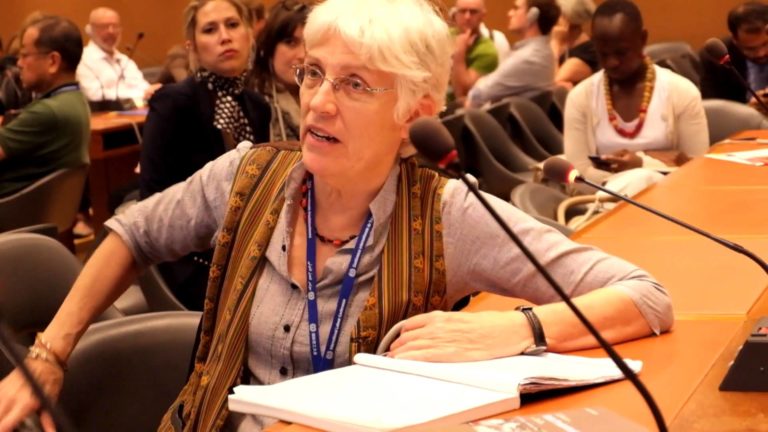
By Pat Horn, StreetNet International Coordinator
Lead-up to Jobs Summit
In his State of the Nation address in February 2018, the new President of South Africa, Matamela Cyril Ramaphosa, announced that a Jobs Summit would be convened as soon as possible to address the problems of joblessness and unemployment in South Africa.
With regard to workers in the informal economy, there was already a process under way on the transitions from the informal to the formal economy after the adoption of ILO Recommendation 204 (R204) in June 2015, under the auspices of the Decent Work Country Programme (DWCP) in South Africa. This process re-started with the active involvement of the Community Constituency (CC) of NEDLAC (National Economic, Development & Labour Council) with the revival of a R204 National Task Team and addition of representatives from the CC in July 2017. I have been representing the CC delegation in these processes via the FSCC (Financial Sector Campaign Coalition). (more…)
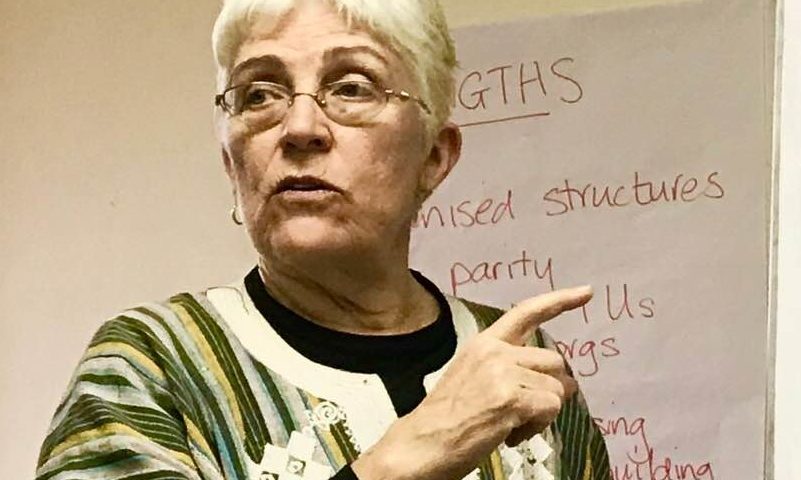
by Pat Horn, StreetNet International Coordinator
Pat Horn, StreetNet International Coordinator shares the progress made towards implementation of the ILO Recommendation 204: (Transition from the Informal to the Formal Economy) in South Africa.
Soon after the adoption of ILO Recommendation 204 (R204) at the International Labour Conference in Geneva in June 2015, the Department of Labour of the Government of South Africa convened a meeting of government (including the Department of Labour (DoL), the Department of Small Business Development (DSBD) and the KwaZulu-Natal Provincial Government) with organised labour and organised business. But they forgot to involve any representatives of workers and economic units in the informal economy!
Meeting attendees established a Task Team – but by 2017 the Task Team had still not done any work. In the meantime, the Community Constituency of the National Economic, Development and Labour Council (NEDLAC) was putting a pressure on the Pretoria office of the ILO and in the Decent Work Country Programme (DWCP) Steering Committee to initiate work on implementation of R204. (more…)
8 July 2016

The South African Informal Traders Alliance (SAITA) will be hosting a National Day of Action march on Wednesday, 13th July 2016. The action is to dispel the ill-held myth that informal hawkers are but of nuisance value, a perception created as a result of unjust socio-economic profiling.
The informal economy is neither a new phenomenon nor is it a creation borne out of desire. That would be an aberration of the truth. We are the first line of defense in a continuous battle against joblessness, hunger, poverty and despair. We could justifiably claim to be of the largest job creators in the country.
Our constituency stretches across the length and breadth of this country and incorporates persons in street/market trading, as well as spaza-shop operators, small-scale fishers, home-based industries, backyard enterprises, waste pickers and other micro industries omitted from formal business institutional norms and practices. School-leavers, the retrenched, the aged, youth, asylum-seekers, refugees, and all those unable to locate work within the formal corporate and public sectors migrate to the alternative economy.
Every 20 years there is a United National Conference on Housing and Sustainable Development (known as HABITAT). The United Nations General Assembly decided to convene, the Habitat III Conference to reinvigorate the global commitment to sustainable urbanization, to focus on the implementation of a “New Urban Agenda”. And the next conference will be held in Quito, Ecuador, on 17-20 October 2016.
In preparation for this, an international campaign called “The City We Need” has been started. We will send the demands of our national “The City We Want” campaign in South Africa to those allies preparing for HABITAT III, so that they can become part of the international New Urban Agenda to be adopted at HABITAT III.
The National Day of Action will be held in the following cities:
|
CITY |
VENUE |
TIME |
|
Cape Town |
Kaizergracht Street, District 6 |
10h00AM |
|
Durban |
King Dinizulu Park, Leo Boyd Highway |
9h00AM |
|
Port Elizabeth |
Corner of Cawood & Goven Mbeki Streets |
10h00AM |
|
Polokwane |
SABC Park, 19 Sri-Lanka Street |
9h00AM |
|
Kimberley |
Indian Centre, Stockdale Street |
9h00AM |
|
Nelspruit |
Mpumalanga Stadium, Ermelo |
9h00AM |
|
Bloemfontein |
Old Ramkraal Prison, Setshabelo Centre, Dr Belcher Road |
9h00AM |
|
Mthatha |
46 Jubilee Square Project, Opposite Boxer Store |
9h30AM |
In South Africa, from restrictions of movement to regulation of economic activities, cities have a list of bye-laws that effectively limit economic development for the poor and encourage evictions. It is time for our voices to be heard, and to make our demands for The City We Want.
We call on all Informal workers, traders, hawkers and those working from their homes and backyards and the media to join the march.
For more information contact:
Cape Town: Rosheda Muller – SAITA Acting President: 078 765 1737
Durban: Mankinto Ngobo – Ubumbano Traders’ Alliance Chairperson: 083 489 7283 (Zulu)
Durban: Asha Moodley – R2K KZN PWG Member: 078 162 4263 (English)
Port Elizabeth: Sorraiya Ahmed – SAITA Deputy Secretary: 078 398 1734
Kimberly: Thusi Jackals – 076 022 3290
Polokwane: Madikoto Samuel Mampapatla – 072 460 7668
Bloemfontein: Maneo Mgwadleka – 072 093 6189
Nelspruit: Makwakwa Siphiwe Patricia – 073 668 0406
Mthatha: Fundile Jalile – Eastern Cape Street Vendors’ Alliance President: 083 574 1129

StreetNet affiliate, Ubumbano Traders’ Alliance, together with members of SASEWA (South African Self-Employed Women’s Association), representatives of minibus-taxi drivers, conductors and washers, and Abahlali base Mjondolo shack dwellers’ organisation, launched “The City we Want” Campaign in Durban, on Wednesday, 9 March 2016.
They were supported by Executive Committee members of SAITA (South African Informal Traders’ Alliance) who came from all 9 provinces of South Africa to attend this launch event. Rosheda Muller, Acting President of SAITA, undertook to ensure that “the City we Want” Campaign is initiated in the other 8 provinces.
This is part of the international “The City We Need” campaign launched by UN HABITAT in preparation for HABITAT III which will be held in Quito, Ecuador, in October 2016.
In South Africa the organisations participating in this campaign will be expecting candidates standing for election in the Local Government elections in August 2016 to pay attention to their demands, if they want workers in the informal economy and shack dwellers to vote for them in the elections.

Informal workers from the sectors of street vendors, home-based workers, taxi workers, fishermen and waste pickers, attended a mass meeting at the Gandhi Luthuli Hall at the Denis Hurley Centre in Durban on 19 August 2015, to discuss the lack of progress in an ILO Project on Decent Work in eThekwini Municipality, involving all 5 sectors, and to look at a way forward with regard to the EMIEF (eThekwini Municipality Informal Economy Forum) and how to transform this into a democratic and representative negotiating forum in eThekwini.
The meeting agreed with the following recommendations by Limpho Mandoro, ILO Social Dialogue Specialist, in his draft report on the consultations on strengthening of social dialogue mechanisms on the informal economy in the eThekwini Municipality:

The new structure needs to include representation from all the abovementioned five sectors of workers in the informal economy, and election of their representatives needs to be done by sector. From the side of the municipality, all the relevant units/departments directly interfacing with the different work sectors in the informal economy need to be part of EMIEF – i.e. not only BSU, but also ETA, Parks & Recreation, etc.
Terms of Reference of the new structure or EMIEF should be revised, not as a unilateral draft by municipal officials, but should be negotiated and agreed by all parties.

The mass meeting agreed that the new restructured EMIEF should become an important vehicle for regular proper negotiations between workers in the informal economy and the eThekwini municipality in the future, to tackle the many unresolved problems confronting informal workers on a daily basis in their work.
This declaration is now being forwarded to the political leadership of the eThekwini municipality as well as municipal officials in the relevant department and the Pretoria office of the ILO.
By Lucky Biyase and Thekisa Anthony Lefifi
CARWASH owner Nathi Mbatha says it is a “sad thing” that both government and fellow South Africans are “quick to refer to us as cry babies and incompetent business people” outclassed by foreigners who are simply working harder.
 Mr Mbatha, who works in Merebank, a low-income area in KwaZulu-Natal, was speaking to Business Times in the grim aftermath of the looting spree that rippled through Soweto and other townships, devastating a number of foreign-run shops and leaving five people dead — including a baby.
The authorities have focused on this key question: was this the first wave of a new round of xenophobic attacks, or simply criminal opportunism?
As the dust clears, it seems evident that there were elements of both, as the cauldron of youth unemployment, municipal incompetence and frustration bubbled over.
While politicians debate the semantics of xenophobia, afrophobia or plain criminality, sentiment on the ground shows that the youth’s disregard for the law is rooted in anger at the remarkable success of the foreign traders, along with frustration at the perceived unwillingness of the government to assist them.
Mr Mbatha attested to this frustration when he described how foreign shop owners were only doing better than their South African counterparts because they had “institutional support from various sources”.
It was a “sad lie” that foreigners did better simply because they offered cheaper prices, he said.
“If you lower your prices in order to wrestle customers from your competitor, you do that because you know you have somewhere to get your stock at a competitive price. The situation here is that foreign business has access to bulk buying due to the support that locals don’t have,” Mr Mbatha said.
Just what this so-called “institutional support” is that has upset so many South African shop owners in the townships is unclear.
These South Africans believe that foreigners are being given hand-outs of “subsidies”, which allow them to build their businesses at the expense of locals.
Mzwandile Mavula, a street trader who sells fruit in Durban, said immigrant traders received “financial support” from various chambers and this has allowed them to “subsidise” their goods, undercutting South African traders.
“In principle we accept them. We also have organisations for informal traders that foreign traders belong to and are protected through these organisations. It is just that these challenges are there,” Mr Mavula said.
But this notion that the foreigners get some sort of “support” seems to be more myth than reality. If anything, they appear more desperate to succeed partly because there is no help, or expectation of it.
The Economist described last year how “an influx of traders from the Horn of Africa and Asia has been a headache for spazas run by South Africans”.
“Informal retailing has swiftly become a foreign speciality,” it said, recounting how most of the buyers at the giant Kit Kat cash-and-carry wholesaler were foreigners who restocked two or three times a week.
“They flit between Kit Kat and other cash-and-carries for the best deals,” it said.
The magazine also cited a study by the African Centre for Migration and Society, which said Somalis were able to gain the upper hand over their South African counterparts by selling goods at lower prices, paying more attention to customer service, offering credit and staying open for longer hours.
That study seems to answer the question raised by Lindiwe Zulu, the Minister of Small Business Development, who fuelled tensions this week by saying that foreign business owners must reveal their “trade secrets” to local business owners.
But the past week’s implosion also illustrated the fact that townships and settlements like Soweto, which were formed during the apartheid-era when black people were forced to live far from white suburbs, have not achieved the sort of economic success many expected.
It’s hard to get a holistic picture as a place like Soweto is now as middle-class in some areas as it is poor in others.
The average monthly income in the Soweto suburb of Protea, for instance, is now R11,400. But what is a problem in most areas is youth unemployment.
A report by the World Bank said the ANC-led government had installed houses in townships, but had given residents scant access to social services. An explosion of informal settlements, such as Diepsloot, also added a heavy burden on services. It is not surprising, then, that service delivery protests have spiked in these areas.
A recent study by the University of the Western Cape has said that there were as many as 28 protests a month in 2012 -a sharp increase from 2007.
John Loos, a property strategist at FNB, said more “turbulence” lay ahead for the country in service protests — especially if economic growth did not expand fast enough.
What also makes it tricky to get a grasp on how township economies operate is the fact that they differ markedly from the economies of more affluent suburbs.
For example, rising electricity and food costs in townships mean that families often buy food on the streets -including spykos (a mixture of tinned spaghetti, sugar beans and fish), fried potato chips, dishes like pap and meat or amanqina (cow heel). Smart and flexible small businesses are cashing in on the low-cost “eating-out” option.
Still, the perception that foreigners are only here to cash in on a distinct local economy hasn’t helped ease tensions.
Mr Mavula, the street trader, said: “As I speak to you, there is an immigrant selling his stock in his car just 3 metres from me, selling the same things. Police can’t do anything to him. But, if I were to go to the toilet now, police would have taken my stock by the time I return.”
The perception is that police target informal local traders — but foreigners are ignored.
“We are supposed to pay for permits — if we don’t have these, we get our stock taken away and have to pay fines. By the time you pay the fine to get your stock back, it will be damaged. Foreigners. normally go from street to street with their products,” said Mr Mavula.
Tashmia Ismail, a faculty head at the Gordon Institute of Business Science, said that evident “bullying” of foreign shop owners was not doing the economy any good.
Ms Ismail runs a business training programme with pharmaceutical giant GlaxoSmithKline, which teaches spaza shop owners marketing and other tricks to boost sales. She said the recent violent events will hit investment in townships.
Mr Loos said the low opening rate of shopping malls in townships was one of the factors holding back the economic development of these areas.
New shopping centres would plough more money into the area, and reduce the cost for residents, who would otherwise have to travel to find big supermarkets such as Shoprite, Checkers and Pick n Pay.
Futuregrowth Property Fund, which has invested in 24 shopping centres in townships, is helping to change things.
But this is a double-edged sword. Plonking giant retailers in townships inevitably puts pressure on local spaza shops, many of the traders believe — compounding the perception that they are already struggling to fight off “foreign competition”.
Smital Rambhai, product manager for Futuregrowth’s community property fund, said this view was wrong.
Most local business owners have adapted and thrived, he said — even as big businesses were entering townships.
And starting a small business is never an easy task anyway. In 2013, Trade and Industry Minister Rob Davies painted a grim picture, saying five out of every seven new small businesses in South Africa closed their doors within one year.
Thami Mazwai, the executive chairman at Mtiya Dynamics and former head of the Centre of Small Business at the University of Johannesburg, said the legacy of apartheid, which barred black people from being entrepreneurs, didn’t help build business skills.
Mr Mazwai said that after 1994, there was an influx of Asians and Somalis who brought decades of experience in the formal economy and quickly captured the market.
“These outsiders also have strong networks as they do not expect assistance from the local government, so they are very competitive. They have their own banks [money that they keep under the mattress] and they help each other,” he said.
Although business chambers such as the National African Federated Chamber of Commerce and Industry had been set up to assist black entrepreneurs, Mr Mazwai said they were “simply not up to it”.
He noted that locals often had an “entitlement syndrome”, which meant they looked to others for assistance, rather than helping themselves -in the way that foreigners would.
Mr Mazwai said: “Yes, the foreigners must integrate themselves into networks with locals for their own survival.
“[But] it is absurd for them to think that they can survive in a network of Somalis in the middle of Khayelitsha. It is downright dumb.’’
This article was first published in Sunday Times: Business Times
Sourced from – http://www.bdlive.co.za/businesstimes/2015/02/01/township-wars–the-myth-and-mayhem